
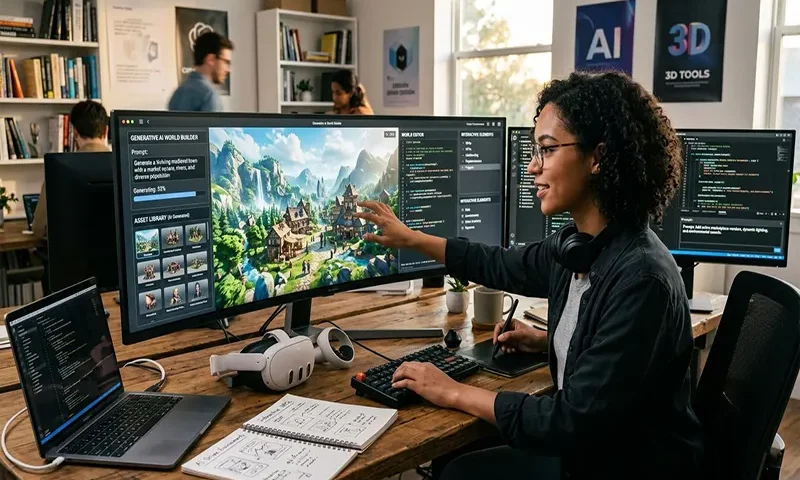
The landscape of virtual world design is undergoing a tectonic shift. We have moved from the era of manual, labor-intensive 3D modeling and scripted behavior into a new paradigm where the environment itself can be conjured through language and intent. Generative AI is not merely a tool for speed; it is an architectural force that allows creators to build environments that are dynamic, responsive, and deeply immersive.
The New Paradigm of World-Building
Generative AI has fundamentally changed how we approach world-building by decoupling the intent of a creator from the execution of the asset. Previously, building a virtual space required hours of polygon manipulation; today, procedural generation algorithms, informed by large-scale generative models, allow for the creation of vast landscapes, architecture, and textures based on textual prompts.
Environmental storytelling is also evolving. Instead of static, pre-written lore, AI enables environments to shift in response to the user’s presence, creating a feedback loop where the world “learns” from and interacts with its inhabitants.
| Generative AI Role | Primary Function | Tools/Examples |
| Asset Creation | Generating 2D/3D textures, models, and skyboxes | Leonardo.ai, Stable Diffusion, Meshy |
| NPC Intelligence | Driving character behavior, dialogue, and memory | GPT-4, Claude, Inworld AI |
| Logic Generation | Procedural terrain, quest trees, and narrative flow | Unity/Unreal Plugins, LangChain |
Creator’s Insight: The biggest bottleneck in AI-generated worlds is performance. Always run your AI-generated 3D assets through an optimization pipeline like Simplygon or Blender’s decimation tools to ensure your polygon counts remain friendly to real-time engines.
The Generative Toolkit
Building a modern virtual world requires a stack that bridges the gap between AI generation and game engine implementation:
- Visual Asset Generation: For textures and environmental assets, tools like Leonardo.ai and Stable Diffusion allow for the rapid creation of high-fidelity visual styles that maintain consistency across an entire map.
- AI-Driven NPC Orchestration: Intelligence is the heart of interactivity. LLMs can be utilized to craft NPC personas, complex dialogue trees, and behavior sets that react to player input in real-time.
- World-Building Frameworks: Integrating these assets into engines like Unity or Unreal Engine is the final step. Specialized plugins now allow for the direct API-based connection between LLMs and engine game-logic.
Creator’s Insight: When generating NPC dialogue, use “system prompts” within your API call to strictly define the character’s knowledge constraints, preventing the NPC from breaking immersion by talking about things outside the virtual world’s lore.
Workflow for Interactivity
Building an interactive world follows a structured pipeline:
- Conceptualization: Start with a text-based “world bible.” Use an LLM to define the aesthetic rules, physical laws, and narrative tone.
- Asset Generation: Generate your environmental assets (buildings, vegetation) based on the rules established in step one.
- NPC Intelligence: Set up your character agents. Define their “memory” systems so they can track interactions with players over time.
- Testing the Loop: Implement the “interactivity loop.” This is the core test: does the AI environment respond meaningfully when the player manipulates an object or talks to an NPC?.
Creator’s Insight: Never feed raw player input directly into an LLM for character response. Use a “guardrail” script to sanitize the input first, which prevents players from using abusive language or trying to “jailbreak” your NPC’s personality.
Addressing Technical and Ethical Hurdles
The ease of generation brings new challenges. Copyright remains a complex issue, especially when generating assets based on the styles of specific artists. Furthermore, managing consistency in AI-generated spaces is difficult; without a strict set of “seed” values or style guides, a world can quickly become visually disjointed.
Technically, optimization is key. An AI can generate a model with millions of polygons in seconds, but that asset must be retopologized and mapped to fit the performance budgets of the engine you are using.
Creator’s Insight: Always use a “style reference” asset in your generative tools. This forces the AI to use your existing assets as a visual anchor, significantly reducing the “uncanny valley” effect when combining AI-made items with hand-modeled ones.
Future-Proofing Your World
We are approaching the age of multi-modal world-building, where the AI understands the world as a cohesive whole, not just a collection of assets. Future tools will likely allow for real-time, multi-modal generation, where text, 3D geometry, audio, and NPC behavior are generated simultaneously and interactively. By building your world with modular API integrations today, you ensure that as these models become more advanced, you can simply “swap in” a more powerful engine without having to rebuild the foundation of your virtual world.

